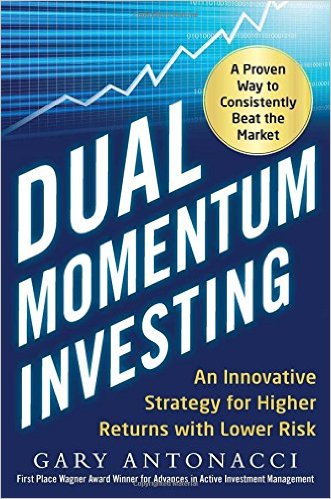

Gary Antonacci spent years managing commodity trading advisors before he came across the academic research on momentum investing. What he found convinced him that momentum was a genuine, durable market anomaly, and more importantly, that it was being used in a way that left most of its potential untapped. His response was to combine two distinct types of momentum into a single framework, test it rigorously across decades of data, and build it into a simple model that takes less than five minutes a month to manage.
That model is dual momentum. Gary’s book on the subject, Dual Momentum Investing, became one of the more influential works in quantitative investing, and his research papers on the topic won back-to-back first and second place awards from the National Association of Active Investment Managers in 2011 and 2012. In episode 9 of Better System Trader, we went through the full framework: what the two types of momentum are, how they work together, what the historical numbers look like, and where people go wrong when they try to modify the approach.
Watch the full episode below, then read on for the complete breakdown.
The story that pointed Gary toward momentum
Gary opens the episode with a story from his time at Smith Barney that shaped his thinking about investing. A market maker named Bob Topol came through to introduce himself to the office. After his presentation, he mentioned that the best investor he knew was his wife Dee.
What Dee had done was simple to the point of seeming like a joke. She was patriotic, so she bought every company she could find with “United States” or “American” in the name. American Motors, American Telephone and Telegraph, US Steel. She also admired generals, so she added General Electric, General Dynamics, General Telephone. She bought these stocks years earlier and never sold.
The room laughed. Gary kept thinking about it afterward. This was before index funds existed. But what Dee had, without knowing it, was a diversified, no-cost, low-activity portfolio completely free from behavioral biases. No transaction costs beyond the initial purchases, no management fees, no glamour bias, no panic selling.
That story launched Gary into thinking seriously about what actually drives investment performance, which eventually led him to the academic momentum literature and, years later, to dual momentum.
Relative momentum versus absolute momentum
Momentum comes in two forms, and Gary is precise about the distinction because they serve different purposes.
Relative momentum compares one asset to another and goes with whichever is stronger. You might compare US stocks to non-US stocks over the past year and allocate to whichever has outperformed. This is cross-sectional momentum, selecting the best-performing asset from a universe.
Absolute momentum compares an asset to its own past performance, specifically to a risk-free benchmark like Treasury bills. If the asset has returned more than T-bills over the lookback period, its absolute momentum is positive and you hold it. If not, you move to a safe haven like aggregate bonds.
Gary explains that relative momentum enhances returns by putting you in the strongest asset at the right time. But by itself, relative strength is still subject to severe drawdowns when markets collapse, because you’re always in something. Absolute momentum adds the timing component, the ability to get out of equities entirely when the trend turns negative. That’s the combination that makes dual momentum distinct.
How the Global Equity Momentum model works in practice
Gary’s flagship implementation, the Global Equity Momentum model, uses two equity asset classes: US stocks and non-US stocks (rest of world ex-US). Here’s the full logic:
- Compare US stocks to non-US stocks over the past 12 months. Pick the stronger one.
- Check whether the winner has positive absolute momentum, meaning it has outperformed Treasury bills over the same 12-month period.
- If yes, invest in that asset class. Hold until the next monthly review.
- If no, move to aggregate bonds as a safe harbour.
That’s the whole system. Monthly review, less than five minutes of actual work each time. Gary anchors it in equities because, as Jeremy Siegel documents in Stocks for the Long Run, equities offer the best risk premium over long periods. The framework keeps you in equities when conditions are favourable and moves you to bonds when they aren’t.
Back-tested over 40 years (the limit of available fixed-income data at the time of the book), the model produced average annual returns over 17% compared to approximately 10% for the S&P 500. Maximum drawdowns on a month-end basis ran around 20%, versus over 50% for buy-and-hold equities.
Why the 12-month lookback and why it’s robust
Gary uses a 12-month lookback period for both the relative strength and absolute momentum calculations. The academic literature supports anywhere from three to 12 months as effective lookback windows, and Gary shows in his book that the model’s performance holds up reasonably well across that range.
Shorter lookbacks get you out closer to market tops and back in sooner after bottoms. The trade-off is more whipsaws, where you exit and re-enter at inopportune times. Longer lookbacks like 10 to 12 months minimize those false signals but produce slightly slower entry and exit signals around turning points. Gary’s view is that the lag at extremes is a small price for the whipsaw reduction.
He rebalances monthly rather than more frequently. Going shorter than monthly, he says, starts to introduce short-term mean reversion effects where you end up reacting to noise instead of trend signals.
Where the excess return actually comes from
I asked Gary during the episode whether the alpha in dual momentum comes mostly from the relative strength component or from the market timing side. His answer was nuanced.
Relative strength plays a real role. Being in the stronger asset class at the right time contributes meaningfully to returns. But a large portion of the excess return over buy-and-hold comes from the absolute momentum timing, from avoiding the severe equity erosion during bear markets.
The logic is simple. When the market drops 50% in a bear market, a buy-and-hold investor needs 100% gains just to get back to where they started. Dual momentum tries to be out of equities when conditions turn negative, which means you sidestep much of that erosion. When the market recovers, you’re picking up where you left off at a much higher level than the investor who rode it all the way down.
The other thing worth noting: when absolute momentum signals moving to bonds, it usually happens around when recession risk is rising. That tends to be exactly when bonds do well. So the two components complement each other not just in terms of the equity holding, but in terms of what happens during the bond phase.
Short-term corrections, whipsaws, and what you have to accept
Dual momentum is a long-term trend following approach. It does not protect you from short-term market corrections. If you’re in US equities and the market drops 10% over a few weeks, you’ll feel it before the 12-month momentum signal changes.
Gary is direct about this: you can’t have everything. If you want a system that also exits during every short-term pullback, you’ll get many more false signals that cost you performance over time. The protection dual momentum offers is against the deep, sustained drawdowns of genuine bear markets, not against every volatile patch in an otherwise upward trend.
He frames this as a feature rather than a flaw. Knowing that the system is designed to protect against the really damaging losses, those 40-50% drawdowns that take years to recover from, gives you the confidence to sit through the shorter volatility without abandoning the approach.
The biggest challenges in running a momentum strategy
Gary names two.
First, sticking with it. Rules-based strategies require discipline, and there will always be periods where the approach feels wrong, where some other strategy has been working and yours hasn’t, where external news makes you want to override the signal. Gary wrote the book partly to give readers enough depth of understanding about why momentum works that they can stay committed during those stretches.
Second, the temptation to tinker. He gets emails constantly from people asking whether they can improve performance by changing this parameter or adding that filter. His answer is always the same: maybe, but you’d need to test it rigorously across a wide range of data, apply it across different markets, verify consistency over time, and make sure your parameters are robust rather than fitted to the historical data you have. Most people who ask aren’t willing to do that work, which means they’re going to end up with something that looks better on paper and performs worse in practice.
Why momentum should persist
Gary makes a point about why he believes momentum is a durable phenomenon rather than a temporary anomaly.
The reasons momentum exists are behavioral. Initial underreaction to news creates inertia. Later catch-up and bandwagon effects cause trends to extend. The disposition effect, where investors sell winners too early and hold losers too long, sustains both phenomena. Herding is documented across natural systems and markets alike.
These are features of human psychology, not artifacts of a particular market regime. They show up in relative strength data going back 200 years and in absolute momentum data going back 800 years across different markets and conditions. Gary’s point is that as long as human beings are making trading decisions, the behavioral patterns that create momentum should persist. The edge may shift in magnitude, but it’s unlikely to disappear entirely.
Get the show notes & transcript
Related episodes
- Episode 67: Jack Vogel on quantitative momentum research and factor investing
- Episode 29: Alan Clement on rotational trading and dynamic position sizing
- Episode 10: Perry Kaufman on market noise and how it shapes your trading strategy choices
- Episode 12: Ernest Chan on momentum crashes, stop losses, and quantitative trading strategy
Want to learn more about momentum-based trading strategies? Subscribe to the Better System Trader podcast for weekly interviews with the world’s top systematic traders and quantitative researchers.