

Andreas Clenow is a hedge fund manager who specialises in developing and trading quantitative strategies across all asset classes.
He is currently a principal at ACIES Asset Management, which he joined after having successfully established his own hedge fund. Prior to his role as a hedge fund trader he had a lightning career with Reuters, where he, as Global Head of Equity and Commodity Quant Modelling, was one of the youngest ever in such a role. He was also the Global Head of Institutional Charting and Technical Analysis for Equis International before departing for the hedge fund world.
He is the author of two books, the first being international best seller ‘Following the Trend’ and the second ‘Stocks on the Move’ has just been released.
In this episode Andreas talks about trend following in stocks, why traditional approaches don’t work and what you can do to account for this. We also talk about trading concepts, cash vs risk allocation, position rebalancing and building robust strategies.
Topics discussed
- The origins of trend following and why a traditional trend following approach doesn’t work on stocks
- Why it’s a bad idea to think in terms of cash allocation and the solution
- Position rebalancing, why, how and when
- How hedge funds look at position sizing compared to retail traders
- Why pyramiding positions doesn’t make sense
- How to get a more realistic understanding of performance results than just a backtest report can provide
- How a random number generator can beat the mutual funds
- How to ensure you strategies are robust and not curve-fit
- Handling large losses or periods of drawdown
- The role of critical thinking in trading
Resources mentioned in this episode
- To learn more about Andreas and his work, checkout his website followingthetrend.com or on twitter
- Books:

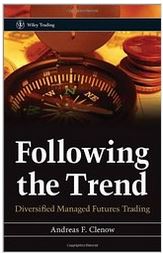
- Additional Resources:
WIN a signed copy of “Stocks on the move”!
This book draw is now CLOSED. The winner was Philip from Wappingers Falls, congrats Philip!
To celebrate Episode 13 of the podcast and the launch of his new book, Andreas has kindly offered a signed copy of his book to give away to one lucky listener.

To be notified of more chances to win books and other products in the future make sure you sign up to the BetterSystemTrader mailing list here:
[mc4wp_form]
Quotes
Top tips from this episode
- Risk allocation vs cash allocation – basing position size on volatility rather than using a fixed position size. If some stocks are more volatile than others but your position size is always the same your risk allocation would be really random, skewed towards the volatile issues. Position sizing based on volatility aims to get the same approximate risk per investment. Each position should have an equal risk contribution to the portfolio.
- Trade a concept – when you trade a concept rather than an optimised model the details don’t really matter too much. In his book Andreas starts off with a reasonable version of a broad concept he knows works, in this case it’s momentum, then he tries some variations that make sense or align with his objectives, to see how the strategy changes and to check for robustness. He doesn’t run optimisations, walkforward testing because he’s trading a broad concept, not an over-optimised model that works on a certain data set. Andreas summed it up quite nicely with this statement:
And frankly at the end I don’t care if you change some parameters and your annualised return go up or down a couple of percent, I wouldn’t go changing anything because it doesn’t necessarily mean anything about going forward. But if I do some dramatic changing on some parameters, I see the end numbers change by a couple of percent, well that probably means those numbers weren’t really relevant in the first place. It doesn’t really matter. They are more or less in that area and let’s keep them more or less in that area. To think you are going to get much better results in the future because you get two percent higher annualised return if you tweak some variable, it’s not very realistic. That’s why I’m insisting you trade the broad concepts, find concepts to trade, not over optimised models.
Got A Question, Topic or Guest you want to see on the Podcast?
Do you have a specific question, topic or guest you’d like to see on a future podcast episode?
Click here and submit your suggestion for a chance to have it featured on an upcoming podcast episode.
Get the Transcript
Subscribe to Better System Trader and never miss another episode!
 |  |  |  |
Please support the podcast by giving an honest Rating/Review for the show on iTunes!